Thursday, October 1, 2009
Importing Intolerance
By Salam Dharejo
"I have had nothing to eat since last night; Ghazi Baba has stopped feeding us and deprived us by closing his doors,” says a 60-year-old woman who has been living at the shrine of Abdullah Shah Ghazi for the last 20 years. The shrine was shut down by the police on June 18, 2009, after it received a terrorist threat.
This marks the first time that a shrine in Sindh has been closed due to the fear of an extremist attack. Shrines of various Sufi saints have been under threat ever since the Taliban began targeting places of pilgrimage, forcibly trying to impose their own religious agenda upon the masses that have been living in peace and harmony for centuries. Due to the deep-rooted influence of Sufism, fanaticism has never flourished in Sindh. However, the proliferation of extremist elements is posing a potential threat to what has been a liberal Sindhi society for many years.
An increasing number of young worshippers in mosques and the trend of growing beards indicate the visible impact of religious preaching. The majority of religiously inclined people seem to live in the urban areas of the province. Abdul Wahab, the peshimam of the Babul Majeed Mosque in Sukkur, is happy to note the increasing number of worshippers: “I have noticed that in the past few years many young, educated persons have been visiting mosques to pray five times a day. It’s worth noting that people do not only come to pray here; most of them help organise religious ceremonies and collect contributions for the expansion and construction of mosques,” Wahab tells me.
The growing inclination towards religion can be gauged through different indicators. The practice of azadari (maatam) for example, has dramatically increased in both urban and rural areas. Today, religious festivals are gaining in popularity; besides Eid, many other religious days are being celebrated all over the country. Modern techniques of celebrating such festivals or days have become an effective tool to engage young people in religious-cum-entertainment activities. For example, Awais Qadris’s style of singing naats has brought significant changes to the age-old form. Consequently, naats have become more popular and younger people now excitedly take part in naat competitions.
Singing has always been a popular form of entertainment in Sindh. Throughout history, singers and poets have enjoyed the patronage of rulers and the monetary support of the public. Today, however, even in the semi-urban areas of the province, extremists are trying to discourage the practice. Just recently in 2008, in Sujawal, a small town in the Thatta district, organisers were warned not to organise a musical function in the town. “Some students from a local madrassa interrupted the show and warned us that they would not allow anti-religious activities and said, ‘If you do not heed us, we will forcibly stop the event,’” poet Akash Ansari, organiser of the musical programme, tells Newsline.
Ishaque Mangrio, a writer and social reformer, is not concerned. “I don’t believe in exceptions; the people of Sindh are liberal in their lifestyle,” he says. “If you look at their culture, you will find that Sufi traditions of tolerance and non-violence form an essential part of their nature. People have a great attachment to their saints: every year, hundreds of Urs are held all over the province and the numbers of devotees are increasing with the passage of time. In interior Sindh, not a single incident of suicide bombing has occurred, and people do not fear going to the shrines of famous Sufi saints.”
On the contrary, Mohammad Ali Manjhi, a local intellectual of Thatta, believes that the preaching of extremist groups is gradually affecting traditional Sufism. “In urban and semi-urban areas, unchallenged religious intolerance and violence is gaining ground. In Sanghar, an addict was killed in front of the police on charges of blasphemy. Not a single protest was carried out by the citizens against the culprits, even though many people knew that the person had not committed any blasphemous act.”
Evidence of a religious tilt in interior Sindh includes the increased number of madrassas in the province. A rapid growth in the construction of madrassas has been witnessed in both the upper and lower parts of Sindh in the last few years. In Sukkur district, the Panno Aqil taluka is famous for religious education – a madrassa is to be found in almost every village. Similarly, in Umerkot district, there are more than 400 madrassas, which proves the all-pervasive religious influence in the area. Growing extremism has played a pivotal role in destabilising religious harmony in the area. Recently, in March, Hindus – who comprise half of the total population of Umerkot – were attacked by Muslims on the day of Diwali, on charges of blasphemy.
The forced conversion of Hindus to Islam has never been a widespread practice in Sindh, but in recent years, thousands of Hindu girls have been forcibly converted. Many Hindu girls in upper Sindh have also been encouraged to marry Muslims. Amrot Sharif in Shikarpur district has become a shelter of sorts for converted Hindu women and, Aziz Shah, the sajjada nasheen, provides all kinds of support and legal aid to the converts. In the past, he has even ensured that their weddings were celebrated and highlighted in the media to help spread the practice.
Similarly, Gulzar-e-Khalil, the village of Pir Ayub Jan Sarhandi in Umerkot, is home to several Hindu women who have been converted to Islam. Pir Ayub Jan Sarhandi claims that he has seen more than 10,000 such conversions. These practices, which threaten the secular fabric of society, have never been publicly condemned by any local organisation or civil society institution, while the religious parties and institutions have actively extended their moral and monetary support for the continuation of such practices.
Although there is no concrete evidence of the involvement of Sindhis in suicide bombings in Pakistan or abroad, many people belonging to interior Sindh have, in the past, participated in jihad. “A lot of people belonging to the Brohvi and Memon communities of Shikarpur took part in the jihad in Kashmir and Afghanistan. Many of them were killed during the war, and their coffins were brought to their ancestral graveyards,” says Paryal Marri, a Shikarpur-based human rights activist.
Earlier, Sufi thought and practices received political and public support. Gaining the support of local pirs and the sajjada nasheen was used by rulers as a means of strengthening their political power. At the time, business communities in Sindh mainly consisted of Hindus, who spent money on the development of shrines and charities. However, business communities are now overwhelmingly Muslim and are thus more likely to extend money to Islamic welfare institutions and madrassas. Additionally, the political patronage of religious forces has increased their influence. Arbab Ghulam Rahim, the former chief minister of Sindh, was actively involved in consolidating Wahhabi institutions in Sindh by providing state support. Furthermore, in upper Sindh, Abdul Haq, the sajjada nasheen of the Pir of Bharchoondi Sharif, Abdul Samad Halejvi of Panno Aqil, Mufti Abdul Wahab Chacher of Rohri and Aziz Shah of Amrot Sharif, are all staunch supporters of Wahhabism and have an immense influence on local politics.
Mazhar Laghari, a political analyst, is of the view that in the absence of any progressive movement and ideology, the growing inclination of the youth towards religion is only to be expected. “I have grown up in the village of Kunri in district Umekot, where my grandfather, Ghulam Mohammad Leghari, the leader of the Hari Tahreek (a farmers’ movement in the late ’70s) turned the village into a camp of revolutionaries. The same village is now nurturing jihadis. The decorated graves of two young persons from the village, who were killed during the jihad in Kashmir and Afghanistan, fascinate the young minds as they are considered to be shaheed.”
Tolerance, equality and non-violence – the fundamentals of Sufism – are rapidly vanishing from Sindhi society, while institutionalised violence, as preached by religious forces, is swiftly proliferating in the province. Shrines have failed to become institutions from where an effective message of non-violence and tolerance can be passed on to the masses. “They (the shrines) are becoming places of rituals that merely provide entertainment to people,” says Manzur Kohyar, a member of the executive committee of Sufi International. So what will be the end result? “Obviously, violence and intolerance will destabilise the social harmony in a society that is already fragile,” Kohyar concludes.

Thursday, September 17, 2009
Women Can't Drive Here, But Children Can!
I drove cars legally in the United States for 40 years before moving to Saudi Arabia. I got an "A" in my Driver's Ed class in high school (shout out to Coach Sharp!) and I have always passed my driver's tests on the first try. I have an excellent driving record. The Kingdom of Saudi Arabia, however, bans women from driving, although out in the sparsely populated areas, women are known to drive there. To my knowledge, it is the only country in the world where it is illegal for women to drive. The most common excuse given for why women are not allowed to drive here is that it's for their own safety and protection. Now this excuse of safety doesn't really refer to the dangers of having or causing accidents. What it actually refers to is the potential for women to have more freedom and to not be under the direct control of a man. The thinking is that a woman driver would have more of a chance to hook up with someone of the opposite sex if she wanted to, which is a big no-no in this country. The funny thing is that I have spoken to many Saudi women who drive outside this country, and they have all managed to avoid becoming sluts - which is what some Saudi men think of all women drivers elsewhere in the world. You can read a previous post I wrote about this subject not long ago.
Granted, the driving conditions here in Jeddah are horrendous. Just imagine all that testosterone gunning those engines in a land where only men are allowed behind the wheel! Traffic laws seem to be non-existent here, and if there ARE traffic laws, nobody follows them and no one visibly enforces them either.
But what really galls me is the fact that I - a responsible female driver with a proven track record of safety and skill and years of experience - am not allowed to drive here in Saudi Arabia, yet frequently I have seen children - specifically young boys - driving who are definitely not old enough to have a driver's license. I have tried to find out the legal driving age requirement here in Saudi Arabia, but that information is as elusive as the traffic laws. I've seen various accounts that range from 17 up to 25, and just about every age in between. All I do know is that many of the drivers I have seen here are nowhere close to approaching their 17th birthday, let alone 25.One day I was crossing the street in a quiet residential section of town, and I was almost run over by a car driven by a boy who looked as though he couldn't have been a day over 10! These young boys drive, stretching and craning their necks in an effort to see over the steering wheel. Many of them have to sit on pillows. I don't know how they can possibly reach the gas pedal, or more importantly, the brake pedal! This is not something I see every day because I am not out and about every day, but it happens with enough frequency that I am not shocked any more when I see it - just angered that I am not allowed to drive here, yet these spoiled little brats CAN. As in many countries of the world, most boys here are raised to believe that they are superior to their sisters and are given special privileges just because they were born with a little extra appendage that girls don't have.
Even though the photos accompanying this post are of poor quality, hopefully you can see that there is a child - I'm guessing he's about eight years old - driving this big SUV on the busy streets of Jeddah AT NIGHT, during Ramadan, when traffic is especially heavy.
In the front passenger seat is a bearded grown man, probably his father, visible in the photo below.

It's hard to make out, but there are two other children in the back seat. None of the vehicle's occupants are wearing their seatbelts, of course. Most Saudis do not wear seatbelts as a rule, nor do they impress upon their children the importance of doing so.
I really resent the fact that I am not permitted to drive here in Saudi Arabia while young boys, who aren't even into double digits in age, can and do, without penalty or objection. I am NOT one of the many fortunate women here in this country who is provided with her own driver and vehicle. Consequently I am stuck at home much of the time with not much to do. My life has been reduced to accepting invitations only when my husband agrees to drive me, which he HATES to do, or when I'm lucky enough to be invited by one of my friends who can send her driver for me. My mobility here is severely restricted, and it is something I cannot get used to. To go from having my own car and the ability to drive where and when I wanted all my life to a country where I cannot is disheartening. Women who are caught driving in Saudi Arabia are usually hauled down to the police station, arrested, and can only be released to their male guardian (see corroborating news article).
To me this whole system makes no sense. Not allowing women to drive causes many hardships on a family, financial burdens if the family has to hire a driver, added stress on the man of the family to drive the women around, inconveniences for everyone, makes it difficult for women to get to and from work (so most women do not work here), and more. Women here in Saudi Arabia face many challenges and barriers created by the men which make it difficult for the women with desires for a more meaningful life to become more valued contributing members of this society. When men here say women cannot drive for their own protection, yet they turn around and permit little boys to get behind the wheel in busy traffic on the streets of Jeddah, putting everyone in their paths in harms way, there is no other word for it than "preposterous." The intended purpose behind not allowing women to drive here is totally flawed and unreasonable. It all boils down to a control issue, aimed at treating women like children and at keeping women at home.
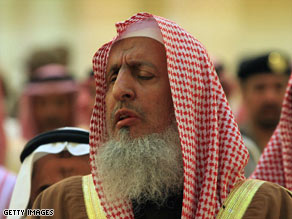
Top Saudi cleric: OK for young girls to wed

Saudi cleric Sheikh Abdul Aziz Al-Sheikh says it's OK for a girl age 10 or 12 to get married.
(CNN) -- The debate over the controversial practice of child marriage in Saudi Arabia was pushed back into the spotlight this week, with the kingdom's top cleric saying that it's OK for girls as young as 10 to wed.
"It is incorrect to say that it's not permitted to marry off girls who are 15 and younger," Sheikh Abdul Aziz Al-Sheikh, the kingdom's grand mufti, said in remarks quoted Wednesday in the regional Al-Hayat newspaper. "A girl aged 10 or 12 can be married. Those who think she's too young are wrong and they are being unfair to her."
The issue of child marriage has been a hot-button topic in the deeply conservative kingdom in recent weeks.
Late last month, a Saudi judge refused to annul the marriage of an 8-year-old girl to a 47-year-old man.
The judge, Sheikh Habib Abdallah al-Habib, rejected a petition from the girl's mother, whose lawyer said the marriage was arranged by her father to settle a debt with "a close friend." The judge required the girl's husband to sign a pledge that he would not have sex with her until she reaches puberty.
Al-Sheikh was asked during a Monday lecture about parents forcing their underage daughters to marry.
"We hear a lot in the media about the marriage of underage girls," he said, according to the newspaper. "We should know that Shariah law has not brought injustice to women."
Christoph Wilcke, a Saudi Arabia researcher for Human Rights Watch, recently told CNN that his organization has heard many other cases of child marriages.
"We've been hearing about these types of cases once every four or five months because the Saudi public is now able to express this kind of anger -- especially so when girls are traded off to older men," Wilcke said.
Wilcke explained that while Saudi ministries may make decisions designed to protect children, "It is still the religious establishment that holds sway in the courts, and in many realms beyond the court."
Last month, Zuhair al-Harithi, a spokesman for the Saudi government-run Human Rights Commission, said his organization is fighting against child marriages.
"The Human Rights Commission opposes child marriages in Saudi Arabia," al-Harithi said. "Child marriages violate international agreements that have been signed by Saudi Arabia and should not be allowed." He added that his organization has been able to intervene and stop at least one child marriage from taking place.
Wajeha al-Huwaider, co-founder of the Society of Defending Women's Rights in Saudi Arabia, told CNN last month that achieving human rights in the kingdom means standing against those who want to "keep us backward and in the dark ages."
She said the marriages cause girls to "lose their sense of security and safety. Also, it destroys their feeling of being loved and nurtured. It causes them a lifetime of psychological problems and severe depression."
The Saudi Ministry of Justice has made no public comment on the issue.Thursday, September 3, 2009
Is there an end to Pakistan’s perpetual misery?
Is there an end to Pakistan’s perpetual misery? Of course, there is no easy answer for this question. Moreover, it also depends on who is answering this untimely and rude question.
If you ask the coalition partners running the government, you are likely to get a tough, but realistic answer. But who cares about tough love, honesty, or facts, or honesty? On the other hand, if you ask the PML (N), you might get figures (don’t worry, they won’t add up in the end!) about how much more revenue can they generate without expanding the pie, bravado and artificial optimism with a caveat. What is that caveat? Well, they would argue, falsely, that if only Nawaz Sharif is given one more chance (never mind his two awful and failed stints) to lead the country, things will improve, inflation, lawlessness, water and electricity shortage and poverty etc will come under control, and believe it or not, it will happen instantly.
So, why can’t we appoint Nawaz Sharif “Amir-ul-Momineen”,? By the way, Nawaz Sharif did try to become Amir-ul-Momineen in 1998, when another man had declared himself Amir-ul-Momineen. Guess who that man was? Yes, Mullah Omar, leader of the Taliban and Nawaz Sharif’s ideological soul mate. But, shhhhhhhhh, don’t share or remind this with the Americans. It seems that American don’t remember Nawaz Sharif’s ties with fundamentalists or his ideological leanings. So, keep it down, will you?
Once Nawaz Sharif takes over as Amir-ul-Momineen, we should give him all the power to control the judiciary, military, press, television, radio, police, secret police, intelligence agencies, banks, embassies, ambassadors, etc to run everything. If you do this, you are likely to have peace in Pakistan within years, or perhaps decades, but, let’s not rush to judgment here. Let the man start work!
But, make no mistake about it. Only a Sharif can govern in this country. What? You don’t believe me? Just look at Punjab where Nawaz Sharif’s party has hundreds of MPS from his own party, but he chose his own brother to be the Chief Minister. Doesn’t this prove that Nawaz Sharif is anything, but serous?
So, isn’t it tempting to have Nawaz Sharif as the leader of Pakistan? In fact, I often wonder, just like Nawaz Sharif (but without staring in the space); why is it taking so long for Pakistanis to fall for Nawaz Sharif’s illusion this time?
Let’s walk down the memory lane to examine facts. Shall we?
During the recent drama to restore a highly questionable man, Ch. Iftikhar as the Chief Justice of Pakistan, Mian Muhammad Nawaz Sharif, leader of one of the 2 dozens Muslim Leagues operating in Pakistan promised, repeatedly, and promised in front of the nation, that if, (and it was not even a big if), Ch. Iftikhar is restored, he, the big leader, Nawaz Sharif would not ask for anything else for five years. I mean come on, you’d think that like rest of the world, I too would remember this promise, but, as you know, perhaps like Nawaz Sharif, I too am a man who regularly forgets commitments. So, please, remind me, every time I forget that Ch. Iftikhar has been restored and it is Nawaz Sharif’s turn to keep his word. Okay?
Anyway, as I was talking about broken promises, or was I talking about Pakistan’s misery? Oh, well, let’s not mix these two because these two are completely separate issue.
By the way, how can anyone define a broken promise? For example, and let’s take the big leader as an example here, if Nawaz Sharif promised the leader of his own party, Junejo, that Nawaz Sharif won’t do anything to damage the party unity, won’t challenge Junejo’s leadership, won’t do anything to destroy the confidence within the party, but ended up destroying party confidence, challenging Junejo’s legitimate leadership and formed his own Muslim League, would it be considered a bad thing? Would it also reflect badly on Nawaz Sharif? All Nawaz Sharif did was that he (some naïve people argue illegally) tried to remove Junejo from the party’s presidency. Why is it wrong to climb up by any means necessary as was done by Nawaz Sharif? No, it is not wrong to climb up, and Nawaz Sharif did not break any law; he just broke couple of promises, and promises are meant to be broken.
This is the Nawaz Sharif way! Get used to it.
It is not good to look in the past all the time, because like Nawaz Sharif, I too am not interested in history, or learning, and pretty much anything else, but I am being forced, by you, the readers, to think of couple of more examples to exemplify Nawaz Sharif as a leader. So, reluctantly and with a heavy heart, I am going to help you understand why Nawaz Sharif is a big leader, and it is for your own good. Take out your notepads, pencils and start taking notes!
What is a leader? A leader is someone who does what he wants to do and this unique leadership quality is found in Nawaz Sharif in ample quantity. Here is how I know Nawaz Sharif is a leader.
Nawaz Sharif showed total lack of trust and respect towards Benazir Bhutto. Benazir, whose father opted to give his life, but refused to compromise on Pakistan’s nuclear program, which he himself started and his daughter thought that after fighting Zia, Nawaz Sharif’s political father, and after being in prisons fighting for democracy, human rights, equality, justice, and democracy, she has somehow qualified as a bona fide leader. So what if her father did so much for Pakistan? So what if he gave his life for Pakistan? Therefore, exhibiting genuine leadership qualities, Nawaz Sharif ignored all the precedent and protocol as Punjab’s Chief Minister and refused to receive Benazir Bhutto at Lahore Airport whenever she was in Punjab.
Comrades, this is what Shakespeare called leadership. This is what Aristotle called character, dignity, and courage, as displayed by Nawaz Sharif. (Yes, Shakespeare and Aristotle did say these things, just ask PML (N) to verify and produce these quotes with the help of Brig Imtiaz!) Take this as another example of leadership because by totally not playing by the rules, Nawaz Sharif proved to the nation his heroic leadership qualities. Abiding by the law, respect for law of the land, being a team player etc is for democratic people and Nawaz Sharif on the other hand wants to solve the problems. Democracy, if we go by the standard and the logic of Nawaz Sharif, is not the answer, it is the problem.
Moreover, Nawaz Sharif has proved to us that being a team player doesn’t help. Nawaz Sharif tried, repeatedly, to be a team player with Benazir, but she wanted democracy. Forget her. Nawaz Sharif tried to be a team player with Asif Nawaz, Waheed Kakar, Aslam Baig, Pervez Musharraf, Ghulam Ishaq, Farooq Leghari, and Sajjad Ali Shah. But, all these important people were not team players either.
I know you might be thinking that if Nawaz Sharif was unable to get along with anyone, even his own handpicked people, isn’t the problem with Nawaz Sharif and not with anyone else? Well yes, on the surface it looks that way that Nawaz Sharif doesn’t have the temperament to get along with pretty much anyone else, but who knows the truth. . So, we should not speculate that Nawaz Sharif was wrong or bad when he fought and quarreled with everyone else. Let’s just say that we don’t know and keep our head in the sand, just like the Americans as for as Nawaz Sharif goes.
By they way, in the interest of full disclosure, I must say that even when Nawaz Sharif was firing army chiefs one after another, I was getting impressed with his talented leadership that is required to get rid of people, but I needed something big from him to give me this confidence that yes, Nawaz can be a leader. And it didn’t take very long for Nawaz Sharif to win me over, completely. I became a full time fan of Nawaz when paid thugs from Lahore, (we should call them signs of strength) stormed the Supreme Court in Islamabad where the then Chief Justice Sajjad Ali Shah was hearing a petition to disqualify Nawaz Sharif because of his corruption, mismanagement of funds and abuse of power etc.
By orchestrating a brave attack on the Supreme Court by thugs, Nawaz Sharif gave me this confidence that no matter how big or serious the problem, Nawaz Sharif has what it takes to fix it, by any means necessary! Hallelujah, bravo, wow, is how I expressed my gratitude towards Nawaz Sharif after his thugs, oops, I meant, his supporters forced the Supreme Court to shut down and Sajjad Shah ran for his life. Ha ha ha, that must have been fun. But, let’s get back to Nawaz Sharif, the big leader.
A leader is a leader and he must employee every tactic to achieve whatever he wants.
There have been other examples of Nawaz Sharif’s character. Just look at the accountability process that he started under the leadership of a supremely qualified man, Saifur Rehman. Everyone in Pakistan was stunned, speechless and crying (with joy of course) as the process of accountability was unfolding. It is also important to note that while the unpatriotic press in Pakistan was publishing stories after stories (false stories, obviously planted by the enemies of Pakistan to destabilize the country and damage the big leader) about the illegal, immoral and unethical Gestapo like tactics to intimidate, malign, and harass foreign agents, otherwise known as political opponents, Nawaz Sharif totally ignored every warning sign that a weak leader might have paid attention to.
By allowing Saifur Rehman to run amok in the country as for as rule of law goes, Nawaz Sharif taught us that a genuine and a strong leader ignores all advise, doesn’t accept or tolerate dissent, and plows ahead, even at the cost of sanity, humanity and decency . By allowing Saifur Rehman to test the limits of everything that stands of a decent society, Nawaz Sharif reached new heights of glory, respect and admiration, not only in Pakistan, but also in FATA.
Another example of exemplary leadership by Sharif brothers is the recent incident at Gojra. Had Punjab been under the rule of PPP, people would have lost lives, property would have been damaged, and hysterical mobs would have played havoc in Gojra. But, thanks to the leadership of Sharif brothers, nothing of that sort took place in Gojra. Just CLICK HERE to get the facts about Gojra and the leadership of Nawaz/Shahbaz Sharif.
There are other examples, where Nawaz Sharif, showing leadership, used the parliament as a rubber stamp, where he hired and fired people at will without any regard for merit or the process, where he openly admitted to be a fundamentalist, which he later clarified that he meant he is a fundamentalist in religious sense, where he routinely aligned himself with right wing anti intellectual, anti common sense, anti progress, anti tolerance forces. Like every other genuine leader in human history, Nawaz Sharif always attempted to crush liberal forces in the country, while fully supporting religious parties. Don’t forget, these religious parties provided the initial frame work for the Taliban, and if given an opportunity, these religious parties have repeatedly promised to emulate Taliban style governance in Pakistan. So, it was only Nawaz Sharif’s leadership that brought these religious parties together to turn Pakistan, a diverse country into an Islamic State where only Sunni Muslim, just like Nawaz Sharif would live in peace and complete harmony! After all, Pakistan was created for only Sunni Muslims, and our big leader can vouch for it. Try asking him this simple question!
Still, if you are on the fence and not totally sure about Nawaz Sharif’s ability to lead the country; let me give you one last example. Do you remember that traitor Musharraf deposed Nawaz Sharif? Do you also remember how Nawaz Sharif fooled Musharraf by signing a confession statement admitting to conspiring against the army chief? Well, Nawaz Sharif fled the country with his family, servants, money, personal belongings, etc, even though he was facing death sentence for his heinous crimes (not my words), but once again, using amazing leadership qualities which at the time of signing confession looked like a cowardly act, Nawaz Sharif went into exile instead of doing time in prison within Pakistan. I mean, what good is a leader if he can’t compromise and save his own skin? Right?
So, in conclusion, I’d say that Nawaz Sharif is a genuine leader. Also, as reported before, he is also a big leader. And, leaders are not bound by any agreement, they act in their interest, and their interest also becomes country’s interest, yeah, ask Nawaz Sharif.
If the current set up is folded, and if democracy fails in Pakistan, and if Nawaz Sharif and his party form the government, the joke is on Pakistan!
Wednesday, September 2, 2009
Baitullah's era
The death of the head of the Taliban in Pakistan appears to have confused the insurgency as much as it has the rest of the world.
![]() |
In that small classroom, the danger was clearly mounting by the minute, as the sound of a US unmanned drone overhead became louder and louder. The more you hear the sound of a drone – bmmmmm – the more it hurts your head. The lower the pitch means the drone is higher in the sky; the louder it is, the closer. Sitting on a chair, I looked through a broken window to see whether I could see any sign of impending attack. There was good reason to be nervous: the man being interviewed was claimed by Washington DC to be ‘hosting’ al-Qaeda in Pakistan, actively engaged in planning attacks on US and NATO forces across the border in Afghanistan. Islamabad, meanwhile, held him responsible for all the major terrorist activities in the country, including the assassination of former Prime Minister Benazir Bhutto.
After the interview, I asked the man about the drone that we had heard. “I have no fear,” said the short, stocky Baitullah Mehsud, the head of the TTP, the umbrella of militant organisations that since early 2007 had spread throughout the tribal belt along the Afghan border. In retrospect, of course, perhaps he should have. On 5 August, a drone killed him at his father-in-law’s house in South Waziristan, in an attack that left his second wife dead as well – if Pakistani Interior Minister Rehman Malik is to be believed. Indeed, the days following 5 August were suddenly rife with rumours, claims and counterclaims, by various governments and those close to Baitullah himself. His lieutenants continue to deny his death, though the 17 August arrest of TTP spokesperson Maulvi Omar seemed to confirm the reports of Baitullah’s death. Either way, this ‘chief terrorist’, whom American and Pakistani intelligence officials have said to be as dangerous as Osama bin Laden, has not been heard from or seen in public since.
How was Baitullah able to create such a large and powerful organisation as the TTP within two years? Personally, I found the man far more mature, serious and intelligent than I have found other militant commanders, such as Nek Muhammad and Abdullah Mehsud. Others agree. “He was gentle and very friendly in his dealings, but that did not hide the real militant within him,” says BBC journalist Haroon Rashid. “He was one of the most dangerous militants … but his biggest weapon was his ability to organise, such as what he did with the TTP – to make it, within a few years into a widespread umbrella organisation.” Indeed, Baitullah’s primary achievement was not his much-expanded militancy network, but how he took the war out of his relatively remote area of Waziristan and directly to the Pakistani metropolis, which are today barricaded and literally under siege. Until his death, he was leading the single largest group of hardened militants in Pakistan, which officials believed numbered some 10,000 – including Pakistanis, as well as Uzbeks, Arabs and other foreign militants. His spending on military activities is said to have exceeded PKR 3 billion (USD 36.2 million) per year.
Dodging drones
![]() |
Baitullah Mehsud, who turned 37 on his last birthday, appeared for the first time in 2004 as deputy to Abdullah Mehsud, another militant leader whom Washington found innocent after keeping him for more than two years in the prison at Guantanamo Bay. Having served as a commander with the Taliban during its rule in Afghanistan, Baitullah formed his own group after Abdullah went underground following Islamabad’s displeasure with his October 2004 kidnapping of two Chinese workers at a key hydropower project in South Waziristan. A strong military push in November 2004 against the Mehsud militants resulted in ‘peace deal’ with Baitullah the following February; since then, there has been little reliable information about the militant leader.
Baitullah was obsessed with the concept of jihad. “Allah on 480 occasions in the Holy Quran extols Muslims to wage jihad,” he used to say when pressed as to why he was waging a war he could hardly sustain. “We only fulfil god’s orders. Only jihad can bring peace to the world.” Accepted Pashtun hatred for invaders ran high in his blood. “Believe me, these infidels want to capture Afghanistan. We should not let them do this,” he said in April 2007. I asked him what logic he could offer for attacks inside Pakistan or on the Pakistani security forces. “The Pakistan Army’s support for the Americans is delaying the defeat of the Americans in Afghanistan,” he said. Baitullah developed his ‘nuisance value’ through small groups in different places, using them as pressure groups against the government to extract concessions in Waziristan.
After the peace deal, the military moved back to its barracks in Wana and other towns in and around South Waziristan. What followed was the targeted killing of a slew of pro-government tribal elders by the militants; all the while, the federal government simply sat on the sidelines watching, as it were. The government had at that time been following a “policy of retreat”, admitted NWFP Governor Owais Ahmed Ghani during a speech on 14 August this year. He said the new policy was to “hold-the-line” against militancy. Yet by the time the government officials began to wake up to reality in 2007, considerable damage had already been done: Baitullah had extended his influence beyond the Waziristan border, far into the NWFP. According to many, the government of the Muttahida Majlis-e-Amal, a conglomerate of religious parties with considerable sympathy for the Taliban that was in power in NWFP from 2002 until 2007, may have assisted Baitullah’s spread across the province.
In the early years of its rule in Afghanistan, the Pakistani Taliban restricted itself to jihad in Afghanistan. However, the militants began to see increased public support in the Pakistani frontier areas following the US-led invasion of Afghanistan in the wake of the attacks of 11 September 2001. This was particularly so as General Pervez Musharraf’s approval rating in Pakistan plummeted following the ‘unprecedented concessions’ that the public saw him giving the US to track down al-Qaeda and Taliban operatives on Pakistani soil. Thereafter, the militant influence spread slowly. Outside of the tribal areas, for instance, there was no attack of any kind until 8 November 2006, when a young suicide bomber walked towards army recruits in the town Dargai, near Swat District, to avenge the 30 October US strike in a seminary in Bajaur during which some 80 students had been killed.
The Dargai attack opened something of a floodgate of militancy across the country by the Taliban, and Baitullah Mehsud missed no opportunity to take credit for every attack his men executed successfully. Pakistanis first tasted real Taliban-style ‘justice’ in Mingora, the district headquarters of Swat, where beheaded bodies were hung in public as a warning to those who could resist Taliban diktat. The violence then spread massively. Within the next year and a half 1366 attacks had taken place with 2686 killed.
Yet similarly disastrous has been the state’s response, something that Baitullah said was good for his own recruiting purposes. In early spring 2007, I asked him, “Your guerrilla tactics may pose a threat to the US and the Pakistani military. But how can you face the US dominance in the sky?” To which he responded, “If the US morale is as high as mine, then we have a long war to fight. If I go on a three-month campaign for the hearts and minds of the civilians, I may win over 50 or 60 people. But a single air strike brings out the whole population, because it kills more innocent people than wanted men.” Indeed, the US drones might be good at taking out wanted targets; but the cost of these attacks seems incredibly high in terms of losing hearts and minds. David Kilcullen, a former adviser to the US Army, has stated that drone attacks inside Pakistani territory are today “creating more enemies” than they eliminate.
Importantly, the Baitullah killing comes following sharp criticism by senior Pakistani civil and military officials of the US role in ‘allowing’ militants to harm Pakistan while specifically targeting militants who are seen as posing serious challenge mainly to American security and strategic interests. Indeed, the US has been seen to focus increasingly on Baitullah’s strongholds in South Waziristan. Last year, the CIA carried out 26 drone attacks in South and North Waziristan and the Orakzai tribal region, mainly targeting groups that cross into Afghanistan to strike against coalition forces. The number of drone attacks also increased significantly following the swearing-in of the Pakistan People’s Party (PPP)-led coalition government on 25 March 2008, with a total of 50 drone attacks having taken place in the last 17 months.
TTP finished?
![]() |
| Iqbal Khattak |
On the assumption that Baitullah is indeed now dead, what is to happen to the TTP? Public sentiment in Pakistan has dramatically shifted towards the government in recent months, with Taliban, be gone! and similar slogans for the first time being seen on Pakistan’s streets. In the past, any time a top militant leader has been killed, the group that he was leading has also quickly disappeared or merged into other groups. The passing of Nek Muhammad and Abdullah Mehsud are both cases in point, with both leaders being replaced by pro-government commanders.
To date, no militant leader has publicly stated that Baitullah is dead. However, in what appears to be a ‘silent coup’, on 19 August the TTP deputy chief, Maulvi Faqir, elevated himself to the post of amir; two days later, Baitullah’s deputy, Hakimullah Mehsud (see photo below), was likewise nominated. Theses are indications of internal differences over the selection of new leader – with rumours of significant violence between potential torchbearers immediately after Baitullah’s alleged death. Regardless, though, the most significant question today is whether the government will finally be able to utilise the current situation to its advantage. One way or another, the war against militancy will not be won unless the damage done by Baitullah Mehsud is undone.
Iqbal Khattak is bureau chief for the Daily Times in Peshawar.
Friday, August 28, 2009
Islamic Radicalism Slows Moroccan Reforms
King Mohammed VI, on horse, held a ceremony of mutual allegiance in July in Tetouan in the north, a hotbed of extremism.
CASABLANCA, Morocco — Morocco has long been viewed as a rare liberalizing, modernizing Islamic state, open to the West and a potential bridge to a calmer Middle East that can live in peace with Israel.
Related
Times Topics: Morocco
But under pressure from Islamic radicalism, King Mohammed VI has slowed the pace of change. Power remains concentrated in the monarchy; democracy seems more demonstrative than real. While insisting that the king is committed to deeper reforms, senior officials speak instead of keeping a proper balance between freedom and social cohesion. Many discuss the threat of extremism in neighboring Algeria.
Since a major bombing of downtown hotels and shopping areas by Islamic radicals in 2003, and a thwarted attempt at another bombing campaign in 2007, there has been a major and continuing crackdown on those suspected of being extremists here.
In 2003, anyone with a long beard was likely to be arrested. Even now, nearly 1,000 prisoners considered to be Islamic radicals remain in Moroccan jails. Six Islamist politicians (and a reporter from the Hezbollah television station, Al Manar) were jailed recently, accused of complicity in a major terrorist plot. The case was full of irregularities and based mainly on circumstantial evidence, according to a defense lawyer, Abelaziz Nouaydi, and Human Rights Watch.
In a rare interview, Yassine Mansouri, Morocco’s chief of intelligence, said that the arrested politicians “used their political activities as a cover for terrorist activities.”
“It was not our aim to stop a political party,” he said. “There is a law to be followed.”
Morocco is threatened, Mr. Mansouri said, by two extremes — the conservative Wahhabism spread by Saudi Arabia and the Shiism spread by Iran. “We consider them both aggressive,” Mr. Mansouri said. “Radical Islam has the wind in its sail, and it remains a threat.”
Al Qaeda in the Islamic Maghreb, especially active in Algeria, remains a major problem for Morocco, Mr. Mansouri said. Officials say it is appealing to the young and has recreated a training route to Afghanistan through Pakistan, and it just sponsored a suicide bombing in Mauritania.
Foreign Minister Taïeb Fassi Fihri said: “We know where the risks to our stability are. We know kids are listening to this Islamic song, so we have to act quickly.”
King Mohammed, who celebrated his 10th year on the throne this year, has vowed to help the poor and wipe out the slums, called “bidonvilles,” where radicalism is bred. One such slum, Sidi Moumen, where the bombers lived, is being redeveloped. Half of it has already been ripped down, and some 700 families shipped to the outskirts of the city, where they are provided a small plot of land at a cheap price to build new housing.
Hamid al-Gout, 34, was born in Sidi Moumen and built his own hovel here. Nearly everyone has been to prison, he said, and Islamist political groups quietly hold meetings. “Sometimes we talk, 12 or 14 people, about our lives,” he said, then added carefully, “But there is no radical thinking here now.”
Abdelkhabir Hamma, 36, said that he had been told that if he and his family did not leave by the end of the year, they would be thrown out. He said that while many respect the king, few trust other authorities.
The king sees himself as a modernizer and reformer, having invested heavily in economic development, loosened restraints on the news media, given more rights to women and shed light on some of the worst human-rights abuses of the past. These are remarkable steps in a region dominated by uncompromising examples of state control, like Algeria, Tunisia, Libya and Egypt.
Because the king, a descendant of the Prophet Muhammad, is also revered as the “Commander of the Faithful,” challenges to Moroccan Islam are taken very seriously.
In March, the king cut diplomatic ties to Iran, accusing Tehran of “intolerable interference in internal affairs” by trying to spread Shiism in Morocco and recruiting Moroccans in Europe, especially in Belgium, to participate in acts of terrorism, Mr. Mansouri said.
The king has tried to be more inclusive, traveling for instance to the north of Morocco, where his father had refused to go. The north is also a hotbed of extremism and home for many of the Qaeda bombers of Madrid. The king held a traditional ceremony of mutual allegiance, or baiaa, this year in Tetouan and highlighted significant development funds there.
But Morocco’s response has also been to slam the brakes on reform, even of the corrupt judiciary and of laws governing women’s rights, in order not to inflame conservative and traditional views of Islam, especially in the countryside and among the poor, where extremists fish. For that reason, too, the king has not put Morocco forward as an interlocutor between Israel and the Palestinians, as his father did. The view here is simply that Israel — and other, harder-line Arab states — must move first, before Morocco exposes itself.
The crackdown has also damaged Morocco’s human rights record. Muslim prisoners are treated roughly in jail, sometimes sodomized with bottles, said Abdel-Rahim Moutard, a former prisoner himself, his hands broken during interrogations. He runs Ennasir, a rights organization for prisoners. But when they emerge from prison, they get little help, even from the mosques or Ennasir.